Location Guides · 6 min read
Published · Updated
In brief
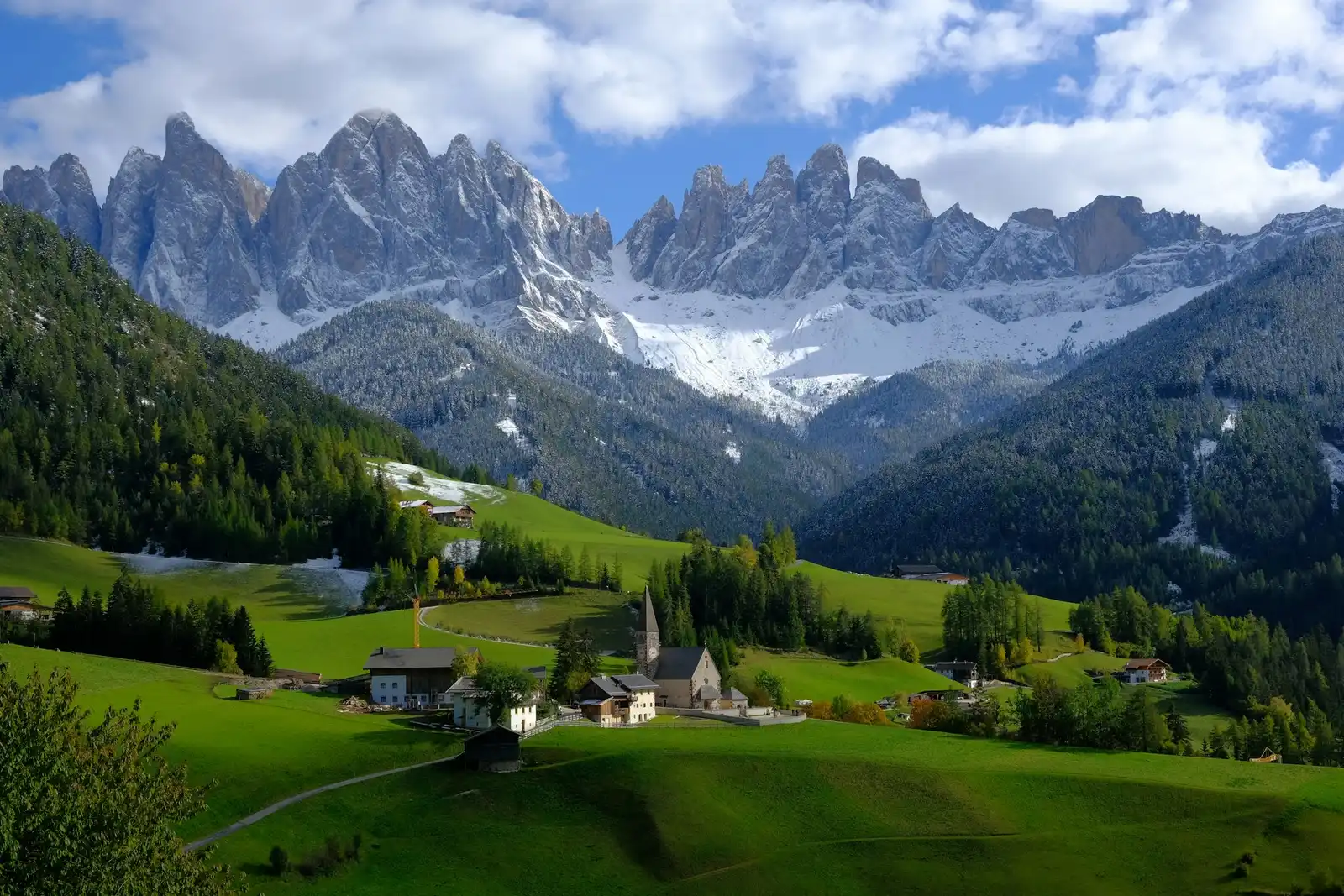
Val di Funes is the single most photographed valley in South Tyrol, thanks to the small baroque church of St. Magdalena sitting alone in a green meadow in front of the jagged Odle peaks — and it's genuinely one of the easiest locations in the entire Dolomites to reach and plan around. Unlike Seceda or Tre Cime, there's no cable car and no serious hike involved: paved roads and gentle meadow paths lead to every classic viewpoint in the valley, which makes it a consistent favourite for couples travelling with family, older guests, or simply without much hiking experience.
Santa Maddalena versus St. Johann in Ranui
The view most people picture when they think of Val di Funes is Santa Maddalena: the little church sitting in isolation in front of the Odle spires, independently one of the most photographed single viewpoints anywhere in the Dolomites. Reaching it involves a walkable panoramic road and trail through open meadow rather than any cable car or lift — but it's worth knowing before you plan the day that you cannot drive all the way to the viewpoint itself. A parking area exists near the separate St. John (San Giovanni, also known as Ranui) church nearby, and the final stretch to the main Santa Maddalena vantage point is covered on foot, along flat, well-marked paths.
The freestanding St. Johann in Ranui chapel, a short walk further into the valley, offers a quieter and more private alternative to the busier Santa Maddalena pull-offs. We secure private key access to the Ranui grounds so couples can capture intimate portraits by the historic chapel without barriers, other visitors, or the crowds that gather at the main viewpoint during the middle of the day. Many couples treat the two churches as two distinct moods within the same short trip: the iconic wide shot at Santa Maddalena, and a quieter, more personal setting at Ranui.
Getting there and what to expect underfoot
Because there's no cable car and no meaningful elevation gain, Val di Funes is unusually accessible by Dolomites standards. Paved country roads connect the villages of the valley, and short, flat, well-maintained walking paths cover the last stretch to each of the main viewpoints. That's a genuinely different experience from the steeper, rockier terrain near Seceda's best-known ridge — if you're comparing locations partly on physical difficulty, see our Seceda vs Alpe di Siusi comparison for how those two stack up, since Val di Funes sits at the easy end of the range across our entire portfolio.
Crowds concentrate almost entirely at the two well-known viewpoint pull-offs near the road; step even a short distance beyond either one, and the valley empties out quickly. That makes early morning or, better still, the golden light of late afternoon the two best windows for having a clear frame without another visitor in it, particularly during the busier summer months.
Best light, best season, and what this means for your dress
Late afternoon light hits the Odle cliffs directly and front-on, turning the pale limestone a warm gold against the green valley floor beneath — the specific effect that makes this valley so instantly recognisable in wedding and elopement photography. For season, late September into early October is when the valley is at its best: the larch forests climbing the lower slopes turn gold, the air clears, and the crowds at both viewpoints thin out substantially on weekdays.
Because there's no cable car queue, no steep trail and no real elevation change to plan around, Val di Funes is one of the few Dolomites locations where a fuller, longer gown works exactly as well as it would at a garden ceremony at home. You won't need the detachable overskirts or trail-ready footwear swaps covered in our mountain elopement dress guide — this valley is close to the one place in our portfolio where those adjustments generally don't matter. That same accessibility is exactly why this is one of our most recommended locations for elopements with family or older guests present, since there's enough flat ground near both Santa Maddalena and Ranui for a small group to stand comfortably to one side without managing a slope or exposed edge.
Building a longer day or trip around Val di Funes
Val di Funes pairs naturally with a second, more dramatic location on the same trip for couples who want contrast rather than two similar settings. A high-altitude ridge session at Seceda, roughly comparable in driving distance, adds the steep, windswept drama this gentle valley doesn't have; a sunrise at Lago di Braies or a quiet plateau session at Prato Piazza adds water or wide open alpine meadow to the itinerary instead. Because Val di Funes needs no cable car scheduling and very little walking, it's also the easiest of the three to slot into a multi-location day without worrying about lift closing times.
If the plan is a full elopement built around Val di Funes specifically, everything from route planning to the Ranui access arrangements is handled as part of our elopement package, so the only real decision left is which season, and which of the two churches, to build the day around.
What this location costs
There's no separate fee for choosing Val di Funes over any other location in our portfolio — it's covered under the same elopement package, from €3,800, that applies across the Dolomites. Because there's no cable car ticket or toll road to plan around here, the day is often simpler to schedule than a location like Seceda or Tre Cime, even though the price itself doesn't change.
That simplicity is also why Val di Funes is one of the locations we most often suggest as a second day within a multi-location trip — the lack of lift schedules or timed access windows means it slots into almost any itinerary without forcing the rest of the week's plans around it, whether that's a relaxed half-day or a quick add-on between two more demanding locations elsewhere in the region.
Frequently asked questions
Do we need to hike to get good photos in Val di Funes?
No — this is one of the most accessible locations in the Dolomites, reachable by paved road and short, flat walking paths to every classic viewpoint.
Is Val di Funes good for an elopement with family present?
Yes, it's one of the best choices for exactly that: easy access, gentle terrain and enough flat space for a small group to comfortably watch from a short distance.
Can we drive all the way to the Santa Maddalena viewpoint?
No — a parking area sits near the separate St. John (Ranui) church nearby, but the final stretch to the main Santa Maddalena viewpoint is on foot, along a flat, well-marked path through the meadow.
What's the difference between Santa Maddalena and St. Johann in Ranui?
Santa Maddalena is the iconic, more visited viewpoint with the church set against the Odle peaks; St. Johann in Ranui is a quieter, freestanding chapel a short walk further into the valley, better suited to more private portraits.
What's the best time of year to photograph Val di Funes?
Late September into early October, when the larch forests turn gold and the crowds at both viewpoints thin out substantially on weekdays.